

Student Health Center

Student Health Center
The Student Health Center takes pride in providing exceptional health care to all Providence College undergraduate students. Students can expect individualized attention and timely service.
Mission Statement
The mission of the Student Health Center is to enhance and support the health of Providence College undergraduate students. We provide compassionate, inclusive healthcare to all students. We are advocates of healthy behaviors and lifestyle choices. Our purpose is to promote overall well-being in a safe, respectful, and welcoming environment and to help students become full and active participants in their healthcare.
Confidentiality
All medical records in the Student Health Center are strictly confidential. Information about a student’s care will be released only with the student’s written permission. All staff adhere to established ethical principles and codes of professional practice, including patient confidentiality. All information concerning students’ visits to the Student Health Center, including their identity, the reason for the visit, and any diagnosis or treatment is considered confidential information.
Excuse Policy
The Providence College Student Health Center, along with most college health centers nationwide, does not provide verification of illness or notes to students requesting a medical excuse for classes or exams. When students request appointments for the purpose of obtaining excuse notes, this reduces the number of available appointments for those students who have immediate healthcare needs. In addition, common medical reasons for missing classes or exams (such as colds, headaches, nausea, vomiting, diarrhea, abdominal pain, dizziness, etc.) do not lend themselves to retrospective objective confirmation.
Announcements & Advisories (25/26 Academic Year)
1/14/26
Flu Advisory 2026
Influenza (Flu)
With the current rise of influenza cases on campus, it is important that students incorporate simple common-sense practices into their daily routine that may help both prevent and contain the spread of upper respiratory illnesses. The flu (as well as other respiratory and gastrointestinal viruses) can spread rapidly among college students due to the classroom settings and living conditions where there are large numbers of people confined to small areas. Providence College follows the CDC and RIDOH guidelines for students testing positive for influenza.
What is Influenza?
The flu is a contagious respiratory illness caused by influenza viruses that infect the nose, throat, and in some cases, the lungs. Nausea, vomiting and diarrhea, sometimes called the “stomach flu” are not the primary symptoms of influenza.
How Do I Differentiate the Flu from Other Respiratory Illnesses?
Influenza has a rapid rather than a gradual onset of symptoms, including chills, fatigue, headache, muscle aches and a high fever (102-104 degrees Fahrenheit or greater). A dry cough, runny nose and sore throat are also typical. Occasionally these symptoms may be accompanied by some nausea and/or vomiting. Most of these symptoms subside within five to six days. However, the respiratory symptoms may last for as long as two weeks before resolving completely. Fatigue and decreased appetite may last even longer. The flu can be diagnosed based on the above history and confirmed with a test specifically for influenza performed on a throat or a nasal swab. Though the flu may make you uncomfortable, most people recover from it uneventfully. There is no indication for antibiotics in the treatment of flu and other viral illnesses. The body’s immune system fights most viral illnesses. Some people may experience complications including pneumonia, ear and sinus infections. People with underlying chronic illnesses are most at risk of complications.
How Does the Flu Spread?
Normal seasonal influenza and other respiratory viruses are usually spread when an infected person coughs or sneezes. The flu can also be spread via contact with objects such as door handles, telephones, keyboards or faucets that have been contaminated with the flu virus. A person then touches his/her mouth, eyes or nose, and the virus starts reproducing in the mucous membranes. Once the flu (or any other viral illness) starts spreading, it is difficult to contain an outbreak on campus. A student infected with the influenza virus can be contagious for one day prior to the onset of symptoms and for approximately five days after symptoms begin. Students are most contagious during the first three days of the illness.
How Can I Avoid the Flu?
Get an annual flu shot. This is your best option for preventing the seasonal flu. A flu shot does not guarantee that you will not get the flu as each year’s vaccine is based on an estimate of which variant of the virus will be circulating. Even if it does not prevent the flu, the vaccine should lessen its severity and the risk of complications. Some people may experience side effects such as a mild headache or a low-grade fever for a day or two after receiving the shot, but the vaccine does not cause the flu. The influenza vaccine is comprised of an inactivated (killed) version of the flu virus. It does take approximately two weeks for you to develop immunity after receiving the vaccine.
A student can decrease the chances of contracting the flu and many other illnesses by following these guidelines:
- Keep your resistance up by eating a balanced diet and getting adequate sleep and exercise.
- Wear a mask.
- Avoid close contact with people who are sick. Keep a distance of three feet or more from a person who is visibly ill with coughing and sneezing.
- Wash your hands frequently or use a hand sanitizer after handling potentially dirty or contaminated surfaces. Use a paper towel or your elbow to turn off the faucet after hand washing as viruses may live on surfaces for two or more hours.
- Avoid touching your eyes, nose, and mouth.
Now That I Have the Flu, What Should I Do?
A few simple control measures can be effective in reducing the transmission of infection. Students should be considerate of his/her classmates and remember the following recommendations:
- If it is an option, students should recover at home.
- Students who remain on campus should self-isolate in their residence hall until they have been fever-free for 24 hours without the use of fever reducing medication (Advil, Motrin, Ibuprofen, Tylenol, and Acetaminophen).
- Wear a mask if you are not in your residence hall until you are no longer considered contagious (fever-free for 24 hours without the use of fever reducing medication).
- Wear a mask to any of the dining areas. Students should take their food “to go” and not unmask to eat in the dining areas on campus or ask a friend to pick up a “to go” food for them.
- Cover your cough and sneeze. Throw away contaminated tissues promptly. If tissue is not available, cough and sneeze into your elbow.
- Wash your hands or use hand sanitizer frequently.
What is The Treatment of the Seasonal Flu?
- Get plenty of rest.
- Drink lots of liquids (at least two quarts or approximately one glass every two hours) – water, juice, Liquid IV, tea, soups, etc. Fluids will help loosen nasal and chest secretions and help relieve your sore throat. In general, it will also help you feel better and recover more easily if you are staying well-hydrated.
- You may take Ibuprofen (Motrin, Advil) or other anti-inflammatories (with food) or acetaminophen (Tylenol) for muscle aches, headache, sore throat and fever.
- You may also use other over-the-counter medications as needed such as throat lozenges and cold and flu preparations per package directions. Additionally, an over-the-counter normal saline nasal spray can help moisturize, cleanse, and clear nasal passages.
- Antiviral drugs can diminish the symptoms of the flu and may shorten the course of the flu by a day, but they must be started within 48 hours of the onset of symptoms. The Student Health Center offers antiviral prescriptions to those with a positive flu test. Antibiotics are of no use in the treatment of the flu and other viral illnesses.
Flu Complications
Most people who get influenza recover in several days to less than two weeks but are likely to experience fatigue and decreased appetite for a period afterwards. Getting extra rest, eating a balanced, healthy diet and making a special effort to increase your fluid intake will help you continue to recover. Some people will develop complications because of the flu, such as pneumonia, sinus infections, or ear infections. The flu can also make chronic medical problems worse. For example, people with asthma may experience asthma attacks while they have the flu. While it is typical with the flu for a person to experience cycles of high fever for several days, seek further medical advice if you experience:
- Difficulty breathing or shortness of breath
- Flu-like symptoms that improve but then return with fever and worsening cough
- Any other symptoms that you feel might indicate a complication
Where Can I Find More Information on Influenza?
https://www.cdc.gov/flu/index.html
https://health.ri.gov/flu-influenza
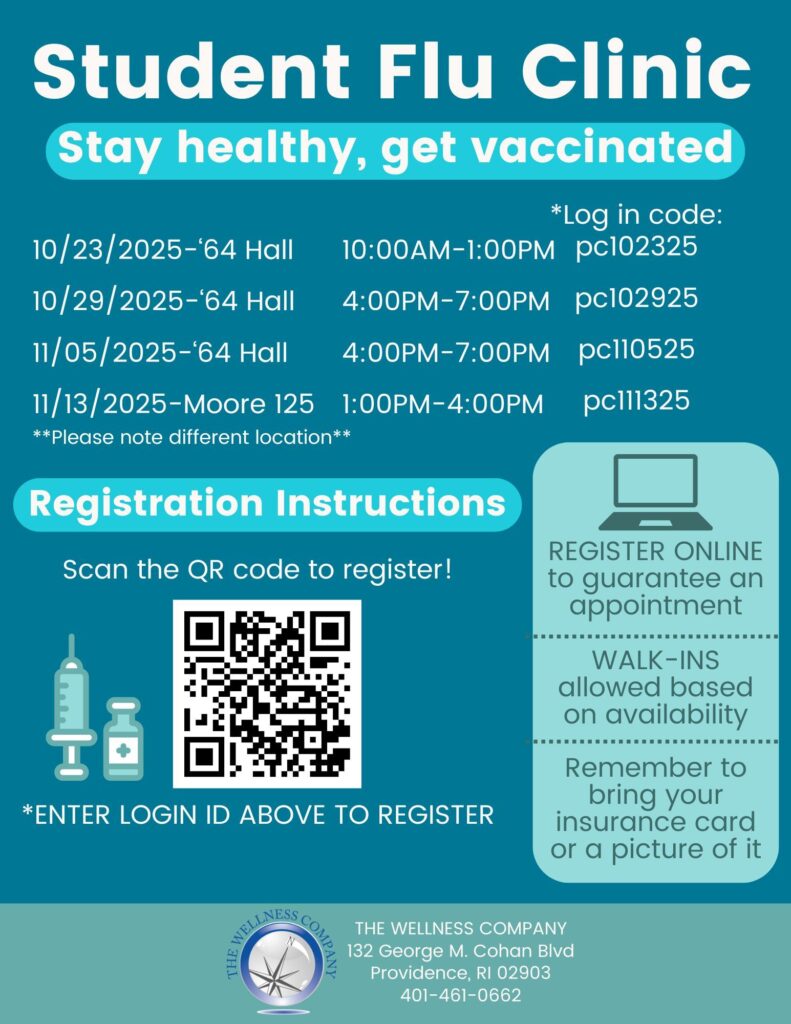
10/17/25
Student Flu Clinics – Fall 2025
6/3/2025
First-Year & Transfer Student Medical Information – Due 7/15/25
Providence College and the Rhode Island Department of Health require that all new, full time undergraduate students (residential and commuter) provide medical information to the Providence College Student Health Center by July 15, 2025. Students need to submit the information only once, before their first year. Returning students do not need to resubmit health records or immunization information. Failure to meet any of these requirements will result in a Health Services hold being placed on your account, which prohibits you from registering/reinstating at the college. Click here for more information.
Additional Resources
Student Health Center
Office Visits: By appointment only during the academic year. The Health Center is closed during Thanksgiving Break, Christmas Break, Easter Break, Spring Break, and the summer.
Office Hours: Monday – Friday: 8:30am – 4:30pm
Lower Davis Hall
401.865.2422
401.865.2809
Public Safety/EMTs
For After-Hours Medical Emergencies (Nights & Weekends)
401.865.2391